Magnum Dom Pérignon 1961
You can read about the previous “mile” on the historic Champagne route here…
…December 2025. The Danish auction house Bruun Rasmussen.
A single bottle is announced for sale: a magnum (1.5 L) of Dom Pérignon 1961 — one of twelve specially prepared by Moët & Chandon for what was called the wedding of the century, the marriage of Lady Diana Spencer and the Prince of Wales.
The bottle was consigned for auction by an unnamed Danish collector. Its pre-sale estimate ranged between €67,000 and €80,000. According to press reports, a representative of the auction house stated that the sale had generated “considerable public interest,” but ultimately the bids “failed to reach the desired reserve price, and therefore, regrettably, the bottle was not sold.”
Let us try to understand why this happened — after all, this is a rare vinous artifact with a long historical shadow.
…29 July 1981. London. St Paul’s Cathedral.
Forty-five years ago.
The royal wedding of Diana Spencer and the then Prince Charles (now His Majesty King Charles III).
Around 3,500 guests were present inside the cathedral, while more than 750 million people worldwide followed the event on television. At the time, it was the largest media event in the history of the British monarchy. The wedding was deliberately moved from Westminster Abbey to the more spacious St Paul’s Cathedral, precisely because of the expected global attention.
At the time, the United Kingdom was going through a difficult socio-economic period, and the wedding was presented as a revival of the “fairy tale of monarchy.” Diana was introduced to the public as a young woman, unpolished and unaristocratic in her manner, someone emotionally close to ordinary people. Her image as the “people’s princess” later became a cultural myth — one that today, in many ways, has proved stronger and more enduring than the image of Charles himself.
It was a perfectly constructed vision of the future, one that, at that moment, few were inclined to question. The wedding was meant to symbolize hope, stability, and the continuity of the monarchy.
Reality, however, turned out to be far harsher than initially imagined. The marriage was deeply unhappy; the relationship was marked by emotional distance, infidelity, and public conflict. The official divorce was finalized in 1996, and Diana’s death a year later radically transformed the public perception of the entire story.
In retrospect, the wedding is no longer remembered as the triumph it was intended to be. Instead, it is seen as the beginning of one of the most dramatic personal narratives of the twentieth century — a historical myth devoid of any sense of a “happy ending.” For part of the public, Charles remains a controversial figure, while Diana’s aura is still powerful, yet increasingly confined to the realm of memorials and remembrance rather than royal grandeur.
But our task here is not to determine who was right or wrong in this story. We are interested instead in the artifacts that accompanied the wedding itself.
And one of those artifacts was Dom Pérignon 1961.
📜 The name Dom Pérignon is associated with the Benedictine monk Pierre Pérignon (1638–1715), who in the seventeenth century served as cellar master at the Abbey of Hautvillers in Champagne. Contrary to popular myth, he did not invent Champagne. His significance lies elsewhere: in the development of key practices that shaped the region’s winemaking — blending, vineyard work, and early forms of quality control.
As a commercial brand, Dom Pérignon appeared much later. It was only in 1936 that Moët & Chandon decided to create a prestige cuvée, produced exclusively in the finest vintages. The first commercial release — the 1921 vintage — entered the market that same year and was aimed primarily at elite and gastronomic circles.
From the outset, Dom Pérignon was conceived as a strictly vintage Champagne, with no non-vintage releases. It was meant to embody exception rather than volume, and to be associated with ideas of time, maturity, and the significance of the moment.
In the second half of the twentieth century, Dom Pérignon gradually evolved from an elite wine into a global luxury brand, actively drawing on cultural, artistic, and historical associations — from state receptions to landmark social events.
One of those events was the royal wedding mentioned above. For the occasion, Moët & Chandon specially prepared twelve magnums (1.5 L) of its finest Champagne, Dom Pérignon from the 1961 vintage. By that time, the wine was already twenty years old. Unlike standard bottles, the total number of magnums of Dom Pérignon 1961 produced by the house was never officially disclosed.
On the labels of this special batch, the following wording appeared.
(an image of the original label can be seen here)
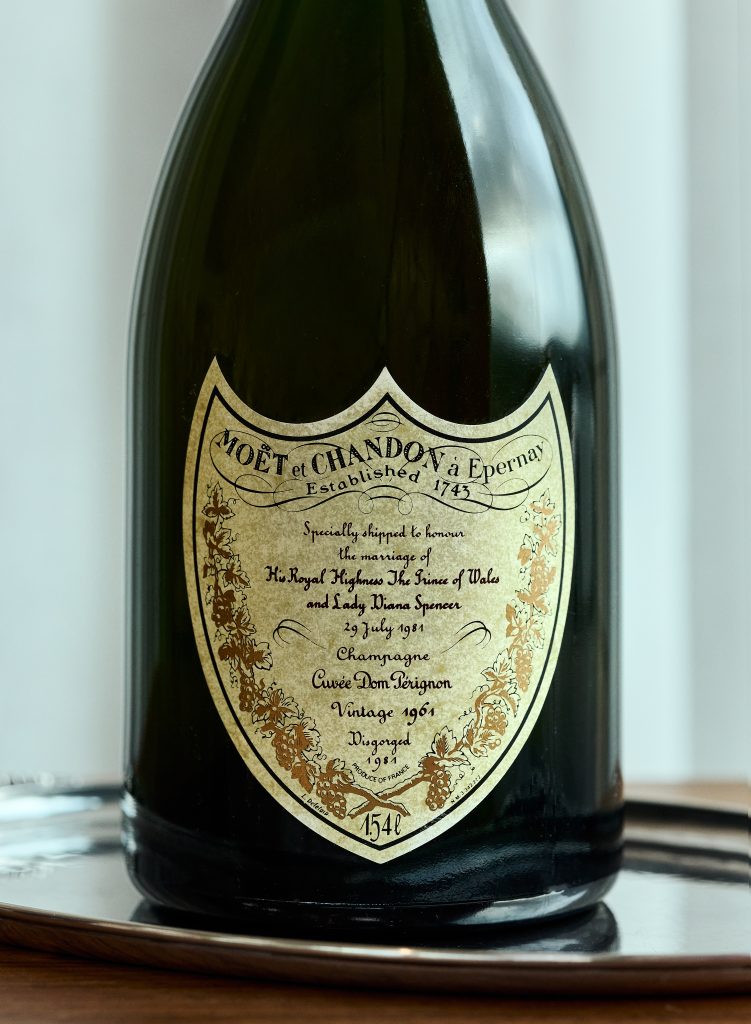
Central text:
Specially shipped to honour
the marriage of
H.R. Royal Highness The Prince of Wales
and Lady Diana Spencer
29 July 1981
Lower section:
Champagne
Cuvée Dom Pérignon
Vintage 1961
Disgorged 1981
Product of France
1.5 L (magnum format)
It is worth noting the precise choice of words. Not “produced for” or “created for,” but specifically “shipped to honour.” In other words, these bottles were not conceived as a separate product line; rather, existing bottles were selected, finished, and formally designated for a particular occasion.
The date 29 July 1981 effectively turns the bottle into a time-stamped historical object.
The notation Disgorged 1981 indicates that disgorgement was carried out specifically for the event. This confirms that the wine was prepared for service, not for long-term preservation as a collectible.
The absence of the words “Limited Edition” further underlines this point. At the time, this batch was not conceived as a collector’s release or an investment product. It was created solely as part of a protocol moment — an element of ceremony rather than an object intended for future speculation.
📜 Dom Pérignon 1961: Why This Vintage Is Legendary
The year 1961 is widely regarded as one of the greatest vintages of the twentieth century in France. It was a warm, sun-filled year that produced wines of exceptional concentration and remarkable aging potential.
► In Champagne, the vintage achieved an ideal balance between ripeness and acidity.
► In Bordeaux, 1961 gave rise to enduring icons such as Latour, Palmer, and Cheval Blanc.
For Dom Pérignon, 1961 stands as one of the most highly regarded vintages in the history of the house. The wine evolved beautifully over decades, and even today the combination of the name and the year carries the weight of an unquestioned classic.
This is not merely a strong vintage remembered by specialists. It is a reference point — a year that continues to define what maturity, balance, and longevity can mean in Champagne.
📜 Why Did Moët & Chandon Do This at All?
In the late 1970s, Dom Pérignon was not yet the absolute, untouchable icon it is often perceived as today. The brand still existed very much within the framework of Moët & Chandon itself. Competition in the prestige cuvée segment was intensifying — Cristal, Comtes, Salon — while the Champagne market was becoming increasingly global, and the notion of a clearly defined “luxury identity” was still in the process of formation.
Dom Pérignon was searching for its definitive place in the pantheon of great wines. For a house of this stature, the key challenge was to move from the category of a great wine into that of a cultural institution.
The royal wedding solved precisely this problem. It embedded the brand within the framework of official historical ritual — Champagne as part of events that claim civilizational significance. In effect, Dom Pérignon was making a statement:
“We are not merely Champagne for celebration.
We are part of history’s ceremonies.
We are ritual Champagne — not simply the best wine in a blind tasting.”

At the time, the release of such a special batch was not designed for resale, auction life, or investment. In the early 1980s, Champagne was not yet thought of as a museum object; today’s auction-driven mindset simply did not exist. The wine was meant to be drunk. It was perceived as part of a meaningful moment, not as something to be stored, archived, or monetized.
Moët & Chandon did this not so much for immediate financial gain as for long-term historical positioning — and in that sense, the house succeeded.
There is no reliable data on how many of the commemorative bottles were actually opened on the wedding day, or how many remained unopened. All that is known is that some of them, bearing this special symbolism, have survived to the present as isolated collector’s objects.

📜 What Is Disgorgement — and Why the Date Matters
► Disgorgement is a technical stage in Champagne production during which the sediment of spent yeast cells, accumulated during secondary fermentation and long aging on the lees, is removed from the bottle. Until disgorgement, Champagne is sealed with a temporary closure, kept in an almost anaerobic environment, and develops very slowly and steadily thanks to its prolonged contact with the lees.
After disgorgement, the bottle is topped up with dosage, sealed with its final cork, and it is from this moment that the wine enters its “life outside the cellar.” At that point, it becomes more vulnerable to oxidation, the aging process accelerates, and the countdown of its public life effectively begins.
► Why is late disgorgement considered an advantage?
The later the disgorgement, the longer the wine retains freshness and structural integrity, the greater its stability during extended aging, and the more complex and layered its aromatic profile becomes. This is why Champagnes disgorged late tend to withstand decades of storage more successfully, are highly prized by collectors, and often show better form when finally opened.
► Dom Pérignon 1961 and the 1981 disgorgement
In the case of Dom Pérignon 1961 prepared for the royal wedding, disgorgement took place approximately twenty years after the harvest, shortly before bottling and service. This means the wine spent two full decades on the lees. It was prepared for drinking, not for long-term collecting. From a technical standpoint, this was an extremely conservative and careful approach.
At the time of the wedding, the wine was therefore in outstanding condition — at the height of its power and balance.
► Why does this matter for the auction story?
For today’s collectors, the vintage year alone is not enough. Equally important is how much time has passed since disgorgement. In the case of Dom Pérignon 1961 disgorged in 1981, we are now looking at roughly 45 years of independent life outside the cellar. This is one of the key factors the market considers when assessing such bottles with caution.
It is also one of the reasons why the auction estimate of €67,000–€80,000 struck many experts as excessively ambitious.
Shortly before the Bruun Rasmussen auction, another bottle of Dom Pérignon 1961 — in the standard 0.75 L format and not associated with any ceremonial event — was sold for £3,200. The difference is striking.
In other words, the auction house applied an extremely high premium for two factors: the double bottle size (magnum) and the historical association with the royal wedding. From a market perspective, this multiplier proved excessive.
In reality, the outcome of the Bruun Rasmussen auction should not be read as a failure, but rather as a sign of market maturity:
• romance no longer sells by itself;
• collectors have become more precise in distinguishing between wine, history, and investment.
This particular magnum found itself caught between worlds.
► Time
Any Champagne — even a great one — is profoundly vulnerable to time.
After 64 years, the risk of oxidation is significant. The fill level, the condition of the cork, and the storage history become critical. The wine may be exceptional, or it may be completely lifeless — there is rarely a comfortable middle ground.
At this point, a fundamental fork in the road appears: why would one acquire such a wine at all?
In reality, there are three distinct wine markets that rarely overlap:
• the market for wine as a beverage;
• the market for historical artifacts;
• the market for investment wines.
► The Problem of “Drinking”
For wine enthusiasts, a magnum of Dom Pérignon 1961 represents a significant risk. At this point, it is no longer simply wine — it is a gamble, at least if the intention is to drink it.
For €70,000, one could instead acquire La Tâche, Musigny, or Haut-Brion in excellent condition — or several pristine bottles of Dom Pérignon Oenothèque / P2 / P3.
Most importantly, the taste of a royal-wedding magnum is not inherently superior to that of a standard 1961 bottle, which sells for a fraction of the price.
► The Problem of “Owning the Artifact”
For collectors of memory and symbolism, the object is also problematic. The bottle has no direct physical connection to Diana herself. It is not unique — twelve were produced, and it remains unclear how many have survived. Was this particular bottle actually present on the table on the wedding day? It is unsigned, undocumented visually, and unsupported by direct provenance.
The aesthetic of Dom Pérignon is important, but it is not cult-like in the way jewelry or clothing can be. This is not Diana’s dress. It is wine that might have been drunk.
► The Problem of “Investment”
Investors today tend to look at such objects with a cold eye. The rare-wine market has become more rational. Provenance, liquidity, and predictability matter more than romance.
When a standard bottle of Dom Pérignon 1961 trades at around €400, and a “royal” magnum is offered at 150–200 times that price, the market inevitably asks a simple question: why?
In other words, this lot failed to fit comfortably into any of the three wine markets.
If forced to choose, most buyers would prefer an ordinary bottle of Dom Pérignon 1961 for €400 over a symbol priced at €70,000.
📜 …A Scene from a Fictional Auction
Two bottles stand on the auction podium.
Both are Dom Pérignon 1961.
One comes from the royal wedding of 1981, dressed in ceremonial livery, wrapped in history, dates, famous names, and a claim to exceptionality.
The other is an ordinary bottle of the same vintage, without titles or biography.
— Look at me, — says the first. — I was served at a royal wedding. I am part of history. I simply cannot be cheap by definition.
— You can, — replies the second calmly. — You just don’t want to.
— But I’m special.
— You’re just old, — the second corrects gently. — And we are both Champagne. We are bought to be opened and drunk — or not bought at all.
The gavel comes down.
The ordinary bottle is taken almost immediately — for €400.
The famous one remains standing, unsold.
— Perhaps, — says the second, now in the buyer’s hands, — it’s sometimes useful to think a little less about who you once were — and a little more about the condition you’re in now.

The first bottle remains silent. Its ambitions still exceed the market’s expectations.
By releasing such a batch, Dom Pérignon made the right decision for its time — an impeccable move for the brand’s reputation — and had no obligation whatsoever to consider the tastes or expectations of collectors in the 2020s.
The rules of the market have simply changed, while the wine itself has remained the same. And the fact that these bottles have survived to reach auction houses today is less a deliberate strategy than a by-product of history.
📜 Where Else Was Dom Pérignon 1961 Served?
From reliably documented sources, it is known that this wine was served at several major historical occasions.
► The 2,500th Anniversary of the Persian Empire (1971)
Rosé Dom Pérignon 1961 was served at the celebrations marking the 2,500th anniversary of the Persian Empire — an event of major diplomatic and cultural significance.
► Summer 2025 — the wedding of Jeff Bezos and Lauren Sánchez in Venice (look here…)
According to media reports, twenty magnums of Dom Pérignon 1961 were ordered for the wedding of Jeff Bezos and Lauren Sánchez. This inevitably prompted direct associations with the iconic wine served at the wedding of Prince Charles and Princess Diana. The Champagne was poured in Venice alongside other elite beverages and became a subject of discussion precisely because it was that legendary vintage — one that commands a very high price.
This is further evidence that Dom Pérignon 1961 has ceased to be merely a wine. It has become a cultural symbol of status, history, and prestige.
📜 The Second Wedding of Charles and Camilla (2005): What Happened to the Wine
Date: 9 April 2005
Format: a civil ceremony at Windsor Guildhall, followed by a church blessing
Character of the event: deliberately restrained, intimate, almost anti-glamorous
★ The Key Wine Decision
At the official reception, there was no emphasis on iconic French Champagne.
Instead, the focus was consciously shifted toward British wines, and in particular English sparkling wines (including Nyetimber and other leading producers), as a gesture of support for national winemaking.
This was not an act of economy, but a deliberate political and cultural choice.
► A Contrast with 1981
• 1981: Dom Pérignon 1961, magnums, a global fairy tale, a French icon.
• 2005: British wines, a modest scale, and a complete absence of vinous grandeur.
This was no longer a fairy tale. It was a mature acceptance of reality.
► A New Image of Charles
By 2005, Charles had distanced himself from the image of the “heir to a fairy tale.” He was actively promoting themes of environmental protection, sustainability, local production, and conscious consumption. The choice of wine for the wedding was part of this new narrative.
► A Rejection of Wine Mythology
There were no special releases, no commemorative bottles, no “wine-symbols for history” at Charles’s second wedding. The event was not designed as a moment to be remembered and re-traded at auctions forty years later.
All of this reflected both the transformation of Charles’s personal image and the evolution of the British monarchy itself.
Dom Pérignon 1961 spent almost twenty years on its lees.
The marriage for which it was opened lasted fifteen.
Not every form of aging is equally effective.
The wine waited for its moment.
The relationship did not.

Two facts stand side by side — one technological, the other human — and time has done its work. It has proved to be a far stricter judge than any auction house could ever be.
Leave a Reply